Cosmology within its set definition is the examination of the universe involving all of its aspects. It is in fact a necessity to examine events that are associated with the development of the modern day world. The modern world is convoluted with a sense of humor, enveloped with antagonistic and regurgitated patterns that are not only meaningless, but all seem to point towards a heavy emphasis on providing more nutrition to the industrial machine. This industrial machine is simply the capitalistic nature of the modern world. Torn from its roots, the modern complex is fixated on production. The left hand does not know what the right hand is doing and therefore is focused on the production of production. It is automated and largely expected to be followed as the way society should conduct its daily life.
The ultimate goal is to produce more, sell more and buy more. However, the mechanical universe that is at the core of modern society has its roots far into the moving history of the human world. In order to understand it, it is best to know how certain aspects of this mechanized world evolved into being from previous cosmological notions.
The Babylonian Cosmology (1900 BCE) saw the world as a spatial connection between Heaven and Earth. The Babylonian deities, being born from the primordial ocean goddess, Tiamat, dictated the way the world was seen. More importantly, the Babylonian chief god, Marduk (male) dominating Tiamat (woman) would serve as a focal point for the Babylonians on how they were to treat gender. More so this cosmology is expressed in Hammurabi’s Code of law in 1900 BCE, defining that women for the most part were treated a little higher than slaves. Tiamat representing the female gender is expressed as something that man must dominate. The Babylonians saw the planets in a form of plurality, considering them to be their deities, displacing their focus of Earth. 2
The Atomist Cosmological view contains that the universe is simply made up of two factors, atoms that are seen as tiny seeds populating the universe and the infinite span of existence, more appropriately referred to as the void. This philosophy, in its natural conception refers back to philosophers Leucippus, 5th century BCE and his student Democritus. Leucippus is the earliest Greek in history to have developed the theory of atominism. Leucippus and his pupil Democritus theories are jointly recorded for the most part and extend into interpreting the world through a series of individualized seeds (atoms), which at times form clusters. Atoms are in a sense indestructible and appear in a variation with respect to size. They move through the void connecting and disconnecting from one another often bouncing off of each other and spiraling further into the void. This theory in concept is representative of how humans, perhaps a larger cluster of atomic composition bounces, connects or disconnects from other clusters (humans) within society. 3
Metaphysical cosmological view will dictate that the world and the universe is a sum (total) of everything within it. The Greeks for the most part did not differentiate between historical/physical cosmology and a metaphysical one. There are simply things that fall beyond the reach of a scientific explanation. Certain aspects of origin, such as questioning how the universe commenced, are perhaps elusive within their explanations. Origin stories still dictate that the Babylonian War God Marduk destroyed Tiamat and from her destruction the Earth, the moon and all other things came into existence. This cosmological view indicates that Tiamat, being a representation of the mother goddess of nature is something to be dominated. Perhaps extending itself to more modern behaviors of humans trying to control and dominate the Earth through machines and other mechanical endeavors. On the other hand the Hebrews claim that God, Yahweh simply thought, and thus existence came into being. To question even the origin of these creators of the universe can lead into blasphemed dead ends. Science however welcomes the questions and gladly does its best to answer them. 3
However, the rise and triumph of a Mechanistic Cosmology prior to the Industrial Revolution was the cause of this evolution in society. The Mechanistic Cosmology, through modern science came through Sir Isaac Newton’s essay, Mathematical Principles of Natural Philosophy. Newton, was able to dominate the realm of science leading the Scientific Revolution. This is important simply because it implied that God created the universe and everything in it as a perfect mathematical machine. Everything could be calculated and nothing was left to uncoordinated chance. Though this philosophy clashed against Theologians and theories found within creation accounts, the idea that God was dead and that modern science was the new successor was adopted for the most part. This ideology was essential in the continuation of mechanizing all aspects of the world. If everything could be calculated through mathematics, then everything should be organized within a similar representation. Thus, the rise of organized industry found its place within the modern society. 6
The Big Bang event was the event that led into the very creation of all that is known. Associated with the aforementioned Atomist Cosmological view found that in the nothingness of the space, there was an explosion, which marked the creation of the universe. Atoms then continued to expand rapidly and creating everything within the universe.
In further analysis, one can contrast a sense of dynamic thematics that run rampant throughout these theories. The atom theory developed by Greek Leucippus and pupil Democritus holds much ground in theory. One can connect this directly to the Big Bang Theory in terms of seeds (atoms) spiraling throughout the expanding universe bouncing and connecting with one another. The same can be held with on of the earliest creation accounts from the Babylonians with the destruction of Tiamat forming the planets (Big Bang). The metaphysical cosmological view is in essence a fail safe, in regard that modern science or logic has not been able to define or find solution to questions, the metaphysical net will catch it stating, that there are things that cannot be explained. In relation to the principals and ethics of the modern world, these fundamental theories are the psychological basis of how the modern day human conducts its daily life.
The rise of the Industrial revolution in the 18th century greatly affected the former complex society by complicating it a little more. This being the first stage of capitalism changed the way the world viewed agriculture, technology and transportation amongst many other facets. The introduction of industry affected society more profoundly on a very integral focal point, which would be taking manual labor and turning it into a mechanical based system. The transition from manual into mechanical was seen and experienced on all levels including transitioning from manual tools to mechanical ones. The spread of industry sprawled through Europe and North America during the 19th century and eventually would consume the world in an automated reign of mechanical terror. The new way of the world was quickly becoming the only way of the world. This mechanized view of the world began to affect the treatment of the worker. 4
History has elaborated on the slave and master dynamic from the early era of Mesopotamian culture, Ancient Egypt and even more recent times with the Cotton States of North America. The dynamic of the employer and employee was no different. The employer is the owner, the master while the employee must do the demands of his/her master so to speak. Though it was not as obvious as its previous incarnations, the flawed relationship was still there. The workers during the rise of industry dealt with very poor working conditions, long days and reduced wages. Intellectuals such as Karl Marx, with his infamous political ideology of socialism inspired many to rise against the industrial machine. Though propaganda, government and other intellectuals would refute Marx ideas, the main ideology behind his socialist view was in a sense an equalitarian society, where the workers would run the factories in a co-op style effort. Before the Neolithic Revolution, such a society existed when both man and woman hunted on equal ground. Neither woman nor man dominated the other because they both practically conducted the same activities; they hunted to ensure the survival of the species. It is only when agriculture entered the hypothetical world stage that the woman, and in turn lesser men (those too weak to hunt or fight) were subjugated in working on maintaining their newly found cities. 2
Cosmologically, this is the way the world was being developed, clusters of atoms being piled together within factories in order to produce more and live less. Marxism was received and adopted by many, and in turn rejected by most. Capitalistic endeavors, having a good handle on media insisted that existence in socialistic based nations produced a poor quality of life. Socialism having evolved into communism was adopted by Russia through the Bolshevik Revolution, Cuba, North Korea, North Vietnam and The Peoples Republic of China through Mao Zedong. However, none of these societies embraced the true ideology that Marx proposed. None of the aforementioned societies have a system in which the workers truly run the factory let alone determine the outcome of his/her life.
In further analysis to the mechanistic nature of modern society, one can see how the thematics all combine together. Democritus along with his teacher believed in the value of atoms. The atoms scientifically can be seen through one lens, but can be acquainted to its representation of humans in their environment through another lens. Atoms for the most part are sporadic and uncalculated within their actions. Though there are patterns and rhythms within their behavior, it is simply an observation in control. The modern day man/woman has been placed under an ideological control that separates them from values that are profound to daily life.
In contrast, Peter Maurin a Catholic Social activist of the early 20th century provided a true account of Marxist ideology. Maurin exercises the thought of a green revolution in which he believes that humans should not only run the factories, but they should exercise personal and religious thoughts at the work place. This concept incorporates the idea that work should not be separate from the other aspects of human life. The reason why society has become mechanized and empty is because of separation, separation of home from work, of religion from work and so on. Maurin believes the human should work much closer to the Earth going back to a more involved angle of manual labor. For the most part this concept is not far off of what is actually needed. As the modern day society rotates closer to more empty space, the solution of how this needs to be dealt with can easily be packaged and sold as yet another product of the industry machine, therefore defeating the purpose of the solution. 5
The modern day society is a train without breaks. Eventually the tracks from under the ride will disappear and perhaps that will be the halt it needs in order to go back to more organic and less mechanical principals. This is not to say that industry is bad or evil. It is the way that it is seen and interpreted that is problematic. On one hand the concept of producing more is a problem. The idea that the modern man/woman is always buying something is a forced idea that has been formulated through media. The retail store year is based around Holidays that are supposed to have a symbolic meaning beyond capitalistic endeavors. These true meanings have been dressed, pushed and manipulated publicly in order to induce a sort of feeding frenzy for industry. Of course, industry provides job opportunities for the worker, which has been the plight since the 18th century and even before that. However, returning to a more organic and less cosmetic way of life would not only incorporate a sense of connection with the work being produced, but it will keep separation between humans at a minimum.
There should be a more profound connection between production and its outcome. The meaningless interaction of selling a product with no other purpose but to acquire financial stability is an empty act. It is unsatisfying within its end result and will only amount to more production. It is a cyclic mechanical back and forth without substance. If there is no meaning behind the act of production, then production and its end result is as well an empty shell that at best represents a workers thoughtless nature. Human origin in all its vastness holds a degree of answers and deep psychological roots that have formed history all the way to modern society. Within the same respect, modern society has the ability; through analysis and pure common sense to adopt a new pattern of living away from its mechanical platform.
Endnotes
1 Barker, Graeme. The Agricultural Revolution in Prehistory: Why did Foragers become
Farmers. 2001.
2 De Mieroop, Mark Van. A History of the Ancient Near East ca. 3000 - 323 BC. 2006.
3 Kahn. Charles H. Anaximander and the Origins of Greek Cosmology. 1994
4 Weightman. Gavin.The Industrial Revolutionaries: The Making of the Modern World.
2010.
5 Day, Dorothy. Sicius, Francis J. Peter Maurin: Apostle To The World. 2004.
6 Newton, Isaac. The Principia: Mathematical Principles of Natural Philosophy. 2010.
Showing posts with label History. Show all posts
Showing posts with label History. Show all posts
Wednesday, March 30, 2011


Wednesday, May 5, 2010
Tuesday, April 27, 2010
Recreating the United Nations

The world is a pretty big place. Even within our modern era there are still many mysteries left undiscovered and unanswered. Within our vast globes, there are multitudes of different cultures, different languages, different opinions and different ways of handling things. When one country talks to another country it’s much like two different planets talking to each other. In many ways, they are alien to one another. Bridges of communications need to be built, ambassadors and translators are then sent over in order to begin the communication platform. Without a proper mediator the two countries are left to fend for themselves. Communication in any relationship is crucial and very vital for its health. In 1919, precursor to the United Nations, the League of Nations was formed as a response to the Treaty of Versailles, which was one of the many peace treaties executed at the end of World War I. 2 The League of Nations primary fixation was on preventing wars between countries. It served as a mediating point for countries to settle disputes before tensions escalated into full-blown war. Unfortunately, the Leagues demise came as Europe spiraled into yet a Second World War. Obviously the League had done its job poorly. In 1945 the United Nations was assembled. 2 Its focus expanded not only to promote peace and prevent war, but also to solve humanitarian, social and economic problems around the world. 1 The United Nations became the new world stage. Its initial intention much like its predecessor was to serve as peacekeepers and as the new global center for all nations of the world. Perhaps the world before the First World War didn’t need a center of communication, but as technology advances, the world’s structure must be regulated in order to maintain balance. Communication is key in maintaining strong and healthy relationships. 3 However, the United Nations was built upon a corporate structure, which happens to be its downfall. The UN is a brand much like many other companies out in the world today. Its need for funding is its very own undoing. Money drives specials interests. It is a tool that can be used to sway decisions, buy friends and apply pressure. Though the UN has a ceiling rate so it never becomes overly dependent on any one country for it’s funding, it still does not mean that a non-paying country cannot apply pressure to the UN, in order to sway decisions made to favor said country.
It’s a double-edged sword.
On one hand, the United Nations should be impartial even to money. It should simply act as its intended purpose defines it; to keep peace no matter what, to maintain a positive economic and social environment and to uphold the respect and application of human rights. How can the original purpose of the UN be upheld if countries have the option of applying pressure to the UN by not paying, in order to push special interests? 5 Currency and the idea of needing a budget has no real place, or should not sway decisions in keeping peace within our world. In all seriousness, what is more valuable, a life or a dollar? Ironically, the proposed question will have a multiple of different answers. That is why the United Nations needs to be recreated.
Famed German philosopher Immanuel Kant, whose philosophies encompassed epistemology, history, religion and law wrote an essay in 1795 called, “Perceptual Peace: A Philosophical Sketch.” 2 Within the body of the essay, Kant proposes a peacekeeping program that consists of abolishing standing armies, states not interfering within the governmental structures of other states, and the opposition of larger states consuming smaller states. Kant’s essay served as inspiration to the League of Nations. 2 The concept of perpetual peace perhaps might sound insincere, but in actuality is what most governments strive for in their own manner. The United Nations, though shy to take its respected place as a would-be empire, has never fully stepped into those shoes. For the United Nations, walking the political tightrope on the world stage is a death-defying act. Not a single empire has ever been in a position to expand their influence over the entire world. Though many have come close, none have succeeded. In an attempt to stretch their wing of influence over the entire world, the Roman Empire 27 BCE comes to mind, the British Empire 1497 CE and in many ways the United States in our modern era through economic empiricism. 2 Amongst all of these would be world leaders; the United Nations is the organization closest in establishing a centralized global peace keeping program. However, the UN’s very own corporate structure keeps it from assuming its proper role in the world.
The United Nations is structure with five principal departments. These departments consist of the General Assembly, The Security Council, the International Court of Justice, the Economic and Social Council (ECOSOC) and the Secretariat. The General Assembly consists of all member states, which currently number at 192. 1 Membership is open to all peaceful nations, which accept the rules and bylaws within the UN’s charter. 4 Ultimately sovereign states are the only ones admitted for membership. Within the General Assembly the direction of general decisions are agreed upon, but not truly finalized. The Security Council serves the role of peacekeeper amongst the countries of the world. The Security Council enforces binding decisions made between countries. 5 The Security Council consists of 15 member states with 5 permanent members, China, Russia, United States, France and the United Kingdom. While the General Assembly represents the majority opinion, the Security Council makes the final call in all matters (welcome to their club). The International Court of Justice, located in the Netherlands is the UN’s judicial department where criminals are brought in to be tried for their crimes. ECOSOC, the Economic and Social Council promotes economic and social developments while the Secretariat, headed by the Secretary General provides resolutions to international disputes, overseeing peacekeeping operations, and organizing international conferences to name a few of its duties. The Secretariat basically serves as the organizing component for the United Nations. 1
Uniquely installed within the United Nations framework are non-governmental organizations (NGO). These organizations, much of them being corporations are usually not directly representing any specific government. While the NGO’s exclude government representatives from having membership within the organization, their money is always welcomed. NGO’s are usually partially funded by governments or are funded fully by them. NGO’s have attached themselves to the main body of the United Nations as extensions that take care of very focused views. The focuses of NGO’s vary in areas of interest ranging from human rights, environment, and children’s rights to name a few. There are millions of NGO’s all around the world. Millions that serve a particular special interest that they lobby. 4 The NGO’s in many ways are misdirected parasites. They feed off of the UN and sometimes blur the intended vision to push their own.
As one begins to look at the structure of the United Nations and it’s attachments, an image of an exhausted Octopus handling many tentacles comes to mind. The United Nations is flooded by decisions on a daily basis. It appears to have become very convoluted in its practice. Politically and ideologically the United Nations has had an inconsistent track record on handling international conflicts, such as the invasion of Iraq by the United States in 2003 CE. 2 The idea of having 5 permanent members in the Security Council is also an unfair structure. These elite nations having originally formed the United Nations off of the cusp of World War 2, have been sitting in their seat of power for way too long. Any nation can be given a serving time on the Security Council but it is not permanent. The idea that 5 nations have the veto power to make any decision pass or fail is open to much criticism. “The Tower of Babble” is a book written by Dore Gold, a former ambassador to the UN that establishes how the UN possibly fuels global chaos. The book goes off to draw a comparison as to where the UN started, with its purpose to incite peace during it’s World War II years, and how it has become a convulsion of decision making in its current state. 6 The John Birch Society wanted the United States out of the UN in 1959, because it felt the UN’s secret goal was to establish a one world government. 2
The idea of a one world government is a complicated issue all on it’s own. I don’t believe that a one world government is where the United Nations should evolve into, as it is faced with much ridicule. Though the UN has been sitting in the best seat, it has not acquired any real authority in terms of respected decision. The United Nations has become a political disaster that simply seems unfair, the primary reason for this being its political and corporate structure. The UN moves like an oversized company instead of a peacekeeping organization. 5 There are innate problems, which seem to be swept under the rug. In order to recreate the United Nations, we must look at its initial purpose. That purpose without a shadow of a doubt is keeping a harmonious global environment. If we strip down the United Nations right down to the bone, peace is what we’ll find. From here, we can rebuild one of the most important organizations in the world. Keeping the peace is obviously not as simple as it sounds. Somehow the world has become wrapped up with the ideas of acquiring money and wealth. These things drive humans to the point of war and the abuse and disrespect of life. Further more, humans forget that we are in fact hanging out on a spinning globe in the middle of the universe. When we put it in that perspective, our bank accounts seem to make less of an impact in our lives.
Keeping the peace across the board should be its primary mandate. Looking at this concept in a more detailed level, establishing and maintaining peaceful interactions within all of the relationships on the planet is much more complex. We live in a world of relationships. We have relationships with everything around us, including other people, animals, plants, buildings, cars and so on. We communicate with these things on a daily basis whether we are aware of it or not. Relationships are tricky because they are based on understanding and communication. If either one of these elements is ignored, conflict arises. The same can be conceived within the relationships between countries. Proper communication and understanding of another country’s position is prerequisite before interactions take place. It is hard to imagine keeping a steady relationship between countries if we can’t even keep a steady relationship at home. 3
Smaller circles represent bigger circles.
In part, education, or re-education is in order. In order to recreate the United Nations, the foundation must return to the ethics it first sprouted from. The citizens of Earth would require a re-education to reprogram the value and proper communication of relationships. Let’s look at the old cliché, ‘do unto others,’ and what it truly represents. First off let us strip this cliché of any religious connection. Let’s simply look at the words and what they imply at face value. Treating other people in the same fashion that you would want to be treated seems simple enough. It is in fact riddled with its own fundamental tragedies. Under this ethical guideline, we will automatically determine that however an individual acts towards others is how he/she would want to be treated. On an individual level, this ethical guideline would work from person to person. Who wants to be treated poorly unless they were reflecting that emotion already? We can apply this ethical concept on a global level. How would countries want to be treated by other countries? I’m sure a smaller country would not want to be invaded and bombed simply because a bigger country has the power to do so. The answer would takes us to a ‘no.’ This universal ethical guideline would serve as the primary moral fundamental towards a ‘new’ UN structure. The rest, if followed by this ethic, would fall right into place. The world in a descriptive utopia would see a change in interactions between the nations of the world. The United Nations would now see a rejuvenated internal ethical structure. The trick from here is to keep it going.
The aforementioned concept of Perpetual Peace, as explored by Immanuel Kant plays with the idea of establishing a state where all nations form under one empirical banner. 2 Since no one empire has ever endured forever, perhaps many nations working together can. What would keep nations from truly working together is the concept of financial gain from activities that integrate to the caring of Earth and all its inhabitants.
The corporate structure that the UN carries now simply holds it back from taking its center role on the world stage. A mishap in bureaucratic decision making that ultimately leads nowhere. If the UN is the umbrella organization that houses all the countries of the world, then it should share resources and level out the playing field. Of course, the very sound of this proposition is laughable when viewed through the perception of economic dominance.
He who has more numbers in their bank account wins.
Ultimately they are simply numbers.
When compared to restoring our Earth and applying a proper universal ethical structure numbers simply do not outweigh it. So the new UN, much like the rest of the world should run on resource sharing as a form of payment, rather than financial trade. Economic dominance is why the United Nations lacks mobility, it has too many attachments and regulations to deal with. Money speeds things up or slows things down. It is the reason why the UN walks on that narrow political tightrope. To do away with this part will allow the UN to take its proper seat in the center of the room.
So far, we’ve reasoned a new ethical application and payment method to the restructuring of the United Nations. Now we will restructure who runs the United Nations. As mentioned before, the General Assembly includes the one country, one vote rule, which applies to all member states. This assembly however is simply viewed as suggestions given to the Security Council. 4 This is where we can see the holes within the UN’s structure. The five permanent members to the Security Council make room in their private club for ten additional temporary seats. However, as mentioned before the five permanent chairs hold absolute veto power over all decisions and circumstances. So even if the General Assembly agreed on something, the Security Council can go the other way with the decision. The General Assembly should be regarded as the final word, and not five distinct nations. It is impossible to conceive that five nations would lead the rest of the world without special interests clashing and dominating their views. However, if these five nations were to be reset and funneled back into the General Assembly’s new ethical position of ‘do unto others’, then the decision making process slightly changes as well. 1
What is being proposed here is the complete reinvention of the United Nations, starting at its very core by installing a new ethical fundamental (do unto others), how people are paid (resource sharing) for their time and how the operating platform of the UN is structured. From here, the United Nations does not have to walk so neatly in terms of being afraid of a contributor not paying because they are lobbying special interest. The UN can be left to do what it was formed to do, upholding and keeping the peace as a global initiative as opposed to a viral condition.
Endnotes
1 “The United Nations Today.” United Nations Publications. 2008.
2 Blackwell Reference Online. “http://www.blackwellreference.com.” 2010.
3 Newman, Dr. Justin. Escandon, Robert J. “Banyan Medical Archives.” 2007 - 2010.
4 United Nations. “http://www.un.org.” 2010.
5 Dr. Willi Scholl. “United Nations.” (lecture, Miami, Florida, 2010).
Monday, March 29, 2010
Applying Revolution to the Modern World
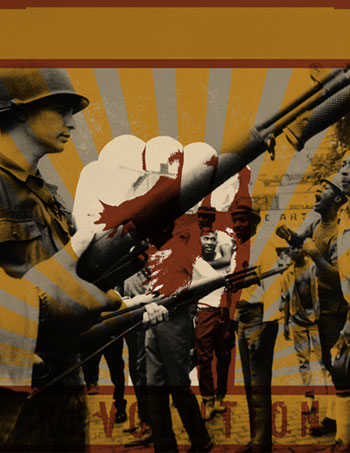
“Applying Revolution in the Modern World”
by: Robert J. Escandon
Revolution is romantic. It unites and forces change on the multitudes under its glorious banner, much like the armed revolt led by Fidel Castro against Fulgencio Batista under the banner of revolution. 5
It’s romantic because it’s tragic. It’s tragic because at times, many die at the hands of the revolution, some are arrested, ridiculed and ostracized all because they oppose a group that represents the majority within society. The majority by all means is never entirely correct. Sometimes, views and opinions change. Martin Luther, responsible for the Protestant Reformation is a rounded example of someone being ostracized because of his views. Luther was excommunicated from the Catholic Church because he demanded change. 5
It seems like revolutions happened much more often in the past than it does now. The current state of the world lends itself to a sort of discreet suppression of ideas and/or any type of revolt through military or intellectual means. This leads to make any attempt at a revolution to roll over on its back before any real momentum is gained. As it is, we simply don’t hear about revolutions in our twentieth century world, especially when we are so far from world conflict to actually care or get involved in it. 7
Throughout the body of this text, we will learn how to incite a revolution within our modern world by looking at how it was done in the past, and by analyzing modern tools that can assist in organizing and executing a revolution.
Thematically, most revolutions are born from a particular discontent towards the mainstream ideology. For the purposes of this essay, we will simply refer to this mainstream ideology as the ‘state’. The state can be any type of collected ideology. For example, the United States represents a profoundly rooted ideology, which manifests within the daily lives of its American citizens. The state, by default is a group of people that have agreed to live under a particular set of rules and regulations. This group is usually composed of high profile, respected figures within society. The psychology behind it communicates that if these professionals being, doctors, lawyers, professors and so on, agree upon a list of rules and ideas, then they should be followed. It becomes popular because more and more people agree upon them. If more people agree upon them, then it becomes the majority rule and therefore implemented as the way things simply are from that point on. 8 The state regulates its followers by enforcing the ideas that have been agreed upon.
This is simply referred to as Nationalism. Think of Nationalism as a gang that is always accepting new members as long as they are willing to abide by the rules and ideas of the gang. Nationalism keeps its citizens regulated through media, propaganda, educational facilities, authorities, specialists and other instruments of the likes to enforce the key ideas that keep the state working properly towards its goals. These instruments are the tools of enforcement and in many ways guarantee that the citizens of the state remain on track and passively obedient. 8 Randolph Bourne, a writer and intellectual is of the opinion that the state is led by intellectuals that seemingly care for the interest of it’s citizens while secretly pushing and forcing secret agendas without any resistance. 7 For those citizens who begin to think outside of the laid out path and fall out from the popular ideologies housed under Nationalism, there are facilities that provide further conditioning to get them back on track. Some of these facilities that are used to reprogram the fallen citizens are, hospitals, jails, educational facilities, rehabilitation centers, psychologists, and psychiatrists to name a few. The idea behind this is that if a particular citizen does not agree with the mainstream ideology, there must be something wrong with them. So by natural logic, if the state and its officials feel that there is something wrong with one of their citizens, they send them off to one of these facilities. For the most part, a criminal who has raped a woman or a child deserves to be rehabilitated with a jail sentence, because they are causing moral harm to others. A citizen that suffers from schizophrenia perhaps needs to see a psychologist or hospital depending on his or her own individual needs. These types of scenarios are self-explanatory. But as we can see, every state, country or established community develops special interests, and thus is where the problems usually begin. Before the Cuban revolution, Fidel Castro was jailed because his ideas differed from the practiced ideologies of the state. 2
The every day citizen dictates their world partially as seen through the media. The reason for this is simply because humans rely on information from others way too much. Funny enough, Historians, the famed composers of our historic timeline value primary sources of information when in actuality, if the Historian wasn’t there to experience it themselves, it is by default a secondary source of information. If this is the prevailing fact, then the citizen must trust in his or herself as experience dictates life. Very little questioning happens because the citizens are usually kept entertained and preoccupied by the diversity of life, bills, death, illness, movies, news and so on. In our contemporary world, citizens are merely handed information, which they willingly accept without thought. However, the special interests developed by the state’s intellectuals are the very divisions that give rise to discontent citizens. We could see a similar event happen with Pol Pots revolution in Camodia. Pol Pot led an Agrarian revolution in order to return his country to more ancient times, simply because he did not agree with direction the leader was taking the country. 5 This can be attributed to a mere difference in opinion, as which is the case with most revolutions.
A citizen, who feels that the state does not represent them fully, might begin to think outside of the mainstream ideology. At first, they might question why it is that they view society differently from their hard working comrades, and indirectly blame themselves for thinking differently. Perhaps there is something wrong with them personally, as opposed to thinking that there might be something wrong with the system they live in. 8 This discontent citizen might begin to develop a new ideology. Sadly, the state will usually not welcome new ideas that can potentially overthrow the established system. It is difficult for the state to welcome new ideological changes simply because they can be construed as revolution. 8
A revolution of any sorts will face public suppression and most likely be forced into an underground movement. The Cuban revolution of 1959 was an armed assault, but it was in fact an underground, guerilla movement between 1956 and 1958. 2 The years leading to the actual engagement between revolutionaries and government were necessary for the Cuban revolution to stick. These years build momentum, strength and more importantly a structure for the new would-be government. After the revolution gains enough wind and enough followers, the revolutionaries must now decide if they will implement their ideas through a peaceful transition or through warfare.
Throughout human history, revolution has always been present, seamlessly forever cycling through our many great societies. Let’s take a quick glance at some of the more ancient revolutions in order to show how much this concept of revolution is embedded within human life. In 2380 BCE we see one of the first revolutions in documented history conducted within the ancient city of Lagash, which resides in Sumer. Unhappy with the actions of King Lugalanda, Urukagina put forth reforms to combat his corruption. Urukagina’s revolution crowned him new king. This revolution also gave birth to one of the first legal codes in history. From a discontent of the established system, a group of revolutionaries, in this case led by Urukagina not only initiated a change in government within the state, but also paved the way for new laws and for a new way of life so to speak. 6 At times these changes are good and perpetuate through the reign of the new empire and at times they fall, much like the new empires. Regardless, the cycle of revolution throughout human history is always very present. In 615 BCE we find the Babylonians who had acquired an allegiance with neighboring states inciting a revolution against the dominant Assyrian empire. Here we can see a revolution conducted by a collection of oppressed states against its domineering parent figure. 5 The Ionian Revolt that ended in 493 BCE was a revolution led by Greek states whom broke free of Persian rule. The Intellectual Revolution that took place between 600 BCE and 400 BCE, was a pre Socratic period in which a particular speculation over the nature of things occurred. In this example, we see a revolution not against another army, but against the oppressing forces of the natural world. In many instances we see success in revolutions, however, we also see many revolutions, which have been subdued. In 181-174 BCE saw the Celtiberian revolution in Spain, which was later thwarted by the Roman Empire. The Roman slave rebellion of 71 BCE, led by the famed gladiator Spartacus was also a failed attempt to over throw Rome. 6 In 18 CE, discontent with the way the system was running, the Red Eyebrow agrarian rebellion took place in China. It was aimed at overthrowing Wang Mang’s Xin Dynasty to reestablish the former Ham Dynasty. The Red Eyebrow was only one of many revolts conducted under the collective name of Chimei. The world’s human history has seen countless of revolutions throughout its course, some of them successful and some of them not so much. The Great Jewish revolts of 70 CE against the Roman Empire, the Nika Revolt of 532 CE in Constantinople, the Saxon revolts against the King of Franks, Charlemagne of 785 CE and even the Wars of Scottish Independence that were waged between the Scottish and the English in 1328 CE are just a few examples of the revolutions waged throughout history. 5 Thematically, these revolts are all part of a desire to change what is established, for something new.
We can see that the concept and implementation of revolution has been a part of human life for centuries in some shape or form. It seems almost natural to rebel against mass opinion and seek change that represents new ideas.
Like anything else in life, revolutions use certain tools in order to implement the intended change. More modern revolutions such as the American Revolution conducted between 1775 and 1783 CE are clearer examples of a revolutions main premise, ‘change.’ However, the way change is actually implemented is an art all on its own. The Americans in an attempt to establish their independence from Britain, were able to give birth to the republic of the United States of America. 5 Using the American Revolution as a tip-off point, we can see how early use of propaganda influences, empowers and justifies a revolution. For one reason or another, the American colonists had contempt for the British. There were arguments and fights that occurred throughout their time together, but for the most part, nothing too disrupting in nature. When the Boston Massacre occurred, an incident that led to the death of five colonists at the hands of the proper British, everything changed. Five people being killed, does not constitute a massacre in any way. However, the Americans used this incident as fuel for their rebellion. Revolutionaries like Paul Revere and Samuel Adams used the Boston Massacre to inspire those who would normally not join their plight for freedom from Britain. 5 Illustrations used at the time will show an army of British soldiers standing in single file line taking their shots at five helpless Americans. When others saw this illustration, they had no problem to find a little hate for their British counterparts thus innately leading to the American Revolution. 1 We can see how propaganda empowers ideology and the impact it has to those who gaze upon it.
1848 was the year that Prussian born Karl Marx and Friedrich Engel’s published the Communist Manifesto. In many ways, this manuscript was another form of propaganda inclined towards the intellectual. This is important because intellectuals are the ones that develop new ideologies. Ho Chi Minh, famous leader during the Vietnam War was an intellectual inspired by the work of Marx. 1 The intellectual propaganda of Marx and Engel’s researched the theory of how the working class affected society and showcased the initial problems with a capitalist structure. The bottom line is simply that the Manifesto was food for thought for many upstart revolutionary leaders. It provided them with a stepping-stone as to where to start. As most revolutions are based on a particular philosophy or a line of logic, the Manifesto inspired the communist revolution of Russia in 1917, China 1926-1949, Vietnam 1945, North Korea 1948 and Cuba in 1959 just to name a few. 2
Another tool used to implement and enforce revolutionary movements is propaganda. The October Revolution, or collectively known as the Bolshevik Revolution of 1917 was an armed insurrection led by Vladimir Lenin, whom was the leader of the Marxist Socialist Party. Lenin is credited with having created the very first modern propaganda machine. Lenin’s use of the simple poster was astounding. 3 The posters used to support the need for the revolution were subtle with their presentation, but very powerful in their use of colors and dramatic engagement. Lenin even used postage stamps, sculptures and even marches to enforce the Bolshevik movement. 1 In fact Lenin used these elements of propaganda through the Bolshevik Era (1917-1921 CE), in which he infused the propaganda with revolutionary justification and empowering symbolism. The New Economic Policy (1921-1927), which served as an era of recovery and freedom for the war torn Russia inspired the masses by using a sort of constructivist feel and style. The two part Five Year Plans led by Stalin were used to push Russia into a full blown industrialized country, using elements in its propaganda that invoked a sense heroism and leadership. 3 The Great Patriotic War (1939-1945) found its propaganda reviving the Bolshevik Era through its use of empowering symbolism, inspiring patriotic responsibility.
Revolutions find much of their roots in intellectual pursuits. As discussed before, propaganda is perhaps the most powerful tool in any revolution. Following this logic, a person that does not know that there is something wrong with the way of things will simply continue to live in the manner in which they are accustomed. This particular citizen might be too busy working and maintaining a daily structure and does not have time to think about the things that might be wrong within their governmental structure. Propaganda is used to inform this citizen of the atrocities being conducted by their government and encourages them to join the fight for change. The support of the masses is only as powerful as the propaganda used to bring them on the bandwagon. 2
In our modern world wars are not only fought on the battlefield, they are fought through the printing press, emails, websites, conversations, televisions, movies and any other media you can shake a memory card at. Propaganda is how an empire retains control. Nationalism, representing the collected ideology of its followers reinforces its ideas daily. Think about America for instance and how every car dealer has a huge American flag waving on its parking lot reminding you where you are, just in case you forgot. Television reminds us of what American families should be striving for, the white picket fence, the dog, the marriage and the kid. Through this use of propaganda we are pushed into a dream that never really seems to develop. This type of propaganda is in many ways is anti-revolutionary propaganda. It is used to reinforce and to establish invisible boundaries as to which citizens are allowed to tread on. Any revolution that is conceived automatically faces the inexhaustible propaganda machine. 1
Taking arms and marching in the name of revolution is perhaps more difficult today, than it was in the years aforementioned. The twenty first century seems to be revolution free for most parts of the world. However, it does not mean that it’s impossible. First and for most let us take our lessons from our global forefathers and think about the need for change. If there is anything that needs to be changed, then a revolution is in order. The scale of this particular revolution is always debatable, but is always linked to the justification of the cause. If the revolution waged is to take down an established government like in the American Revolution, then a larger group is needed to incite it. If the revolution is perhaps less involved, such as a change in corporate structure, then a smaller group is favored. All in all, the justification for any revolution is established through either a philosophy or a logical structure of grievances. Once this is established and justified, then the seeds of change can be planted and grown. Once this is done, the information must be passed on to all who meet the targeted demographics. 2 Any who are affected by what the revolution is going against will most likely jump on the bandwagon.
Within the structure of the twenty first century, the internet is a tool that can be used to peak interest. However, nothing can truly beat a statue that represents a particular array of symbolism, even a billboard and snail mail holds more weight than the information highway. The reason for this logic is simple. When a normal everyday citizen is on his/her computer they are bombarded by information. They are checking their email, watching a video, listening to music, talking on the phone, surfing the web and so on. With all of this going on, the information absorbed on the internet is as important as a Saturday morning cartoon, momentarily vital but dismissed soon after the credits. Digital means are supportive of a revolution but are not final nor beginning turning points. Physical real world examples hold more ground because revolution purges on emotional and logical factors. The digital world at times is seen as ‘not real’ and can be dismissed once the computer is turned off. Propaganda is passed around, followers are gathered and the revolution itself begins to face the opposition of the established ideology. If the revolution is strong, then it will prevail. If it is weak, then it will fail. 1
More importantly, revolutions can be conducted in a peaceful manner.
Endnotes
1 Goldstone, Jack A. “Revolutions: Theoretical, Comparative and Historical Studies.” Wadsworth Publishing. 2002.
2 Defronzo, James. “Revolutions and Revolutionary Movements.” Westview Press. 1996.
3 Pipes, Richard. “Concise History of the Russian Revolution.” San Val. 1996.
4 Gaddis, John Lewis. “The Cold War: A New History.” Penguin Press. 2005.
5 Blackwell Reference Online. “http://www.blackwellreference.com.” 2010.
6 Harman, Chris. “People’s History of the World.” Verso. 2008.
7 Bourne, Randolph. “The War and the Intelectuals.” http://www.bigeye.com/thewar.htm.
1979.
8 Luttwak, Edward N. “Coup d’Etat: A Practical Handbook.” Harvard University Press. 1979.
Wednesday, January 13, 2010
“The Progression of Human Thought in the 50’s and 60’s”

Spiraling through World War I and II, the United States of America found themselves in a silent war filled with threats, espionage and a race to establish themselves as a superior world power. The Cold War all on it’s own engaged the US to begin a forward thought process that would eventually open their awareness to think outside of the proverbial box. The Cold War was a global scenario that pushed the multinational citizens of Earth to reconsider their approach and overall view of life. Lets think of it this way, World War II, was quite straightforward in terms of categorizing the bad guys from the good guys. The Allied forces were seen in its majority as the good guys and the Axis powers were seen as the bad guys. There was an overall air that the collected nations stood against Germany in their advance of achieving world domination. The thinking at this point was very straight forward even in terms of how the enemy would attack and what strategies would be used to thwart their efforts. Upon Germany’s defeat, the world found itself in the clutches of the Cold War, allies soon turned into enemies and the methodology of how to implement and execute a silent war went into effect, and thus human awareness began to escalate and build. This catalyst began in 1945, would be the encouraged the worlds people to think about their circumstances a little differently.
1955 introduced the world to Herbert Marcuse’s work entitled Eros and Civilization. This book, fundamentally is a logical marriage between the philosophies introduced by Karl Marx and Sigmund Freud. 1 The composition argues that the very nature of capitalism is an instrument that is used to prevent society from reaching its expected non-repressive plateau. Marcuse states that there is a defined struggle between what is known as human instinct (common sense) and the repressive nature of social standpoint. 1 The breakdown of our society in the eyes of Marcuse is as follows; there is a major conflict between workers and the capitalists that put them to work. 1 The problem has and always will remain within the philosophical practices of capitalism. However, this idea of capitalism has many forms, one of them being the idea of a segregated United States. African Americans for a long time were simply viewed as labor and nothing more. Within this viewpoint, African Americans were often viewed as instruments rather than human beings; expendable and for the most part inferior to their capitalist masters. Repression is part of histories repetitive cycles, but within the stage of the 50’s and 60’s it was one that would be challenged and ultimately changed.
Coincidentally, the American Civil Rights Movement began in 1955. African Americans introduced the fight for equality through non-violent means. On it’s own, the choice to express their discontent in a peaceful fashion perhaps confused the White segregationists that probably expected a violent rebellion. The White segregationists were most likely prepared to fight off the rebellion of their slaves using guns and violence were bested with a rebellion based on intellect and strategy. African Americans and their leaders used demonstrations such as boycotts, marches, speeches and a general attack on the flaws of the very system of America and the illusion of its freedom. As the human expansion continued, the Civil Rights Act of 1964 banned discrimination within areas of public accommodations and employment. 2 The Civil Rights Act of 1964 was followed by the Voting Rights Act and the Immigration and Nationality Services Act of 1965. 2
White segregationists saw the world as equal and fair before the American Civil Rights movement began. Their perspective of the reality that surrounded them was one justified by what they perceived the truth to be. However, as the saying goes, there are two sides to every coin, and the African American side of this particular coin did not share the same perspective.
Change was needed.
In order to expand, change is required. Without change, a human being cannot hope to expand and learn. Without change, a stagnation of life occurs. While change is always thought about and mentally welcomed, the true motion of change is often repelled. 3 This primarily deals with Human comfort zones and how we will do everything in our power to remain within them. An all out war between the United States and the USSR would have easily answered the question of who was more powerful in a faster manner. The same can be said about the White segregationists and the African Americans involved with the Civil Rights Movement. However, while violence would have declared a victor faster, the time period of the 50’s and 60’s promoted a different type of wind. The world hot off the hells of World War II required a different approach to the presented problems. The world was unknowingly developing a multi-angled view of the world and of life itself.
After being involved with the Vietnam War for 3-years of endless battles, 1968 introduced the American’s to North Vietnam’s Tet Offensive. On January 31st, the Tet Offensive took place and was a major turning point in the Vietnam war. The day was declared to be a cease fire due to a national holiday. However, things did not go exactly as planned when the North Vietnamese commenced the unexpected attack. It demonstrated to the US that the so-called enemies were not only well equipped, but also far smarter than the US had anticipated. The affect of this attack was not in the actual physical fight, but rather the involvement of the media throughout this matter. For the first time ever, families in the United States had the privilege of watching slaughtered bodies on prime time television. Thousands of families watched as the bodies of dead soldiers from both sides of the lines were seen and presented to a public audience. In a way, the North Vietnamese won the war because of the outcome that ensued after the offensive. For the first time, the war was real and President Johnson was then faced with a very unhappy American public. 4 Ho Chi Minh, the leader of the North Vietnamese forces, was a misunderstood countryman that within his justification, wanted the French out of Vietnam in order for the Vietnamese to lead the country themselves. 5 Ho Chi Minh was well aware of the political and social dilemmas within the US during this time period. The information highway of the time was television, and through television the American public was swayed to turn against their own government, as they rallied for the troops to come back home.
Information is power.
Within the United States, the justification for the war was to suppress communism. This was the main idea for the US, to stop the red threat. That’s why the USA joined France against the North Vietnamese. It is the same reason, why the US was involved in the Korean War, and why they stood against the small country of Cuba. They were fighting the red spread. If one looks at the Communist Manifesto by Marx, it strictly states the perfect conditions for a true communist state. A country that is ripe for communism is one that the middle class holds the majority of power within an industrialized state. 6 The process of industrialization took Europe almost 150 years to achieve within its own Industrial Revolution. 7 These other countries that claimed communism, China, North Vietnam, USSR and Cuba were in reality using a version of communism that they adapted to their own construct. While the seeds were dropped, the cultivation of such a system would never truly reach its true form. However, such an understanding could only be realized by stepping in the shoes of another, something perhaps that the US was not entirely ready for, or was it?
2001 a space odyssey was a film directed by the great Stanley Kubrick, which depicted the ascension of man through the known world and into the unknown space around us. The film was released in 1968 and marked an eye-opening spectacle of the senses. Before this, there was nothing quite like it. This film exercised the thematic of this time period perfectly, the exploration of the new. Art represents life and life is represented within art. As the space race continued within the frostbite of the Cold War, the Americans, very anxious to beat the USSR to the moon launched their Apollo 8 shuttle, which was the first manned vessel to leave the gravitational pull of the Earth. 8 Life representing art and art representing life took on a whole new meaning. The base mechanics of the Cold War and the achievements of the US thematically relied on establishing the undeniable power of one country over another.
This time period was one filled with questions. Black Panthers alongside Hippies questioned the systematic structure of US society and politics. In a book written by Alan Watts entitled ‘The Book on the Taboo Against knowing Who You Are’, he illustrates that the very nature of man is one based on the conflict between the illusion of the self and the ego. 9 Humans are always looking for the ultimate answer to life and the question of origin. Alan Watts, who published this book in 1966, worked with the concept of the universal whole. The universal whole is an idea that consists that everything in existence is interconnected and is actually one in the same. It provides one with an unannounced respect for all things around us and within us. The idea developed within Watts book, is one that encapsulates the signs of the time. In this irrevocable understanding, ego is the true enemy. Lets look at this theory within the construct of the Cold War. If this philosophy were to be introduced to that scenario, the US and the USSR would see that they are a part of one planet. Within this one planet, it is better to live in harmony versus a futile attempt at demonstrating who’s more powerful. The struggle for power is a meaningless entry, but within a male modality, it is an extremely challenging detail to change. 3
This era in American History is the catalyst for everything that is experienced in modern day. It shows how innovative human thought has become in comparison to the 50’s and 60’s. It is a growth within itself not only intellectually, but spiritually as well. The thematic of being part of a whole is one that is still exercised in many circles today. It is what the Civil Rights Movement was fighting for, what the North Vietnamese were trying to express and one that is still an important aspect in human life today. If we truly saw ourselves as a sum of whole, which is simply divided into different aspects, we would be able to truly live within a harmonious understanding. But the seeds planted back then are still being cultivated today. Much like it was back then, patience and the understanding of the different perceptions and justifications with our world are very much needed and in full effect.
Wednesday, October 7, 2009
Iraq, The Land of the Gods - History

Amidst the war and turmoil that stamps the Middle East as a hot bed of activity, we can find the rich mythology of Iraq taking a back seat. Iraq is scarcely known as the cradle of civilization. If we look back at the year 3,500 BC, Iraq was then known as Mesopotamia. Southern Mesopotamia gave birth to the worlds first complex civilization, which included the technologies of science, mathematics, cosmology, worship, economy, government, written language and architecture to name a few. Mesopotamia, whose first civilization was Sumer, is a mystery to human beings even today.
For years, the west had believed that our civilizations were directly taken from Greek and Roman cultures when in fact, it all stems from the very first civilization, Mesopotamia.
The brief history of modern Iraq is one of constant conquest and turbulence.
Once the Middle East has been settled, how will future Historians interpret the occurrences and events that are taking place within Iraq today? Within the heated mystery of the Middle Eastern desert, a question arises, why are the US troops so involved in conducting the pacification of this particular part of the world? There is a brief part of the Mesopotamian mythology that covers the God’s creation of the Human Being. Originally, according to Sumerian myth, Anu, the supreme God and Ki, the Goddess of Earth gave birth to a set of lesser Gods called Anunnaki. These lesser Gods, the Anunnaki were meant to do the daily work of the Gods, much like slaves. The Anunnaki, unsatisfied by this lesser work, demanded their own slaves to do their work for them. They assisted the greater Gods in the creation of yet another race to work the daily chores, much like slaves would. This new race was ironically the Human Race.
Funny, humans originally were created as a slave race. Which on its own account would explain a lot about the very nature of Humanity and their actions.
Eventually, much like all subordinates, the humans, much like their predecessors the Anunnaki, rebelled. After this rebellion, it is said that Human Beings lived in the cities freely, though the Anunnaki remained involved in daily human activities.
Perhaps, the resistance and tension that is felt in the Middle East today, is simply an echo of the enslavement that had occurred in Ancient Iraq years ago. Though this proposed pacification might never be attained, the fact of the matter is very apparent.
Modern day Iraq is as much a puzzle today, as it was in the days that sprang forth the complex civilization of Ancient Mesopotamia. It can be hypothesized, given the mythology of Iraq that they would fight a war of freedom against what they view as a potentially oppressive force, the United States. Perhaps modern day Iraq, reminded of their indentured origins, simply view the United States as a modern day collection of Anunnaki masters trying to once again enslave them.
Perhaps, this is the case.
Tuesday, September 29, 2009
A Revisionist - History

Revising History
When Historians look back into the very books and stories that make up the construct of our society, they look back through their own life perspective. As we know, someone looking back at the events of 1968 for example from the year 1969 will have a different interpretation than that of a person looking back from the year 2008. Perspectives change through 'time' and so does the way we interpret them. It is inevitable to look back into history without having our own perspectives influence how we interpret the material.
Revisionism is the ability to change how we interpret history. Much like revisions of a book, this is the case. History is constantly changing. Funny to hear, but very true. For example, there is a book called "The Tragedy of American Diplomacy" by William Appleman Williams. This book is constantly revised along with the state of the nation. It is always being expanded and added to in order to reinforce the presented argument. The same way this is revised, is the same way Historians and Philosophers apply historical revisionism within the annals of History.
As our minds and perspective change, so does the way we interpret old material.
Lets think about it momentarily, within the dynamics of the Civil Rights Movement of 1896-1954 that ultimately roots within the American Civil War of 1861-1865. Back then, in cases such as Brown v. the Board of Education that overturned segregation within Educational facilities, they seem fairly easy to figure out from the viewpoint of one standing in 2009. Integration seems like a logical choice while segregation does not. Our views have expanded and the difference between right and wrong have completely been altered from past popular beliefs .
Facts are facts. But the interpretation of those facts is bendable through perspective. It's important that this realization truly roots itself within Historical Scholars today. The structure that is presented to us is simply that... a presentation. It is flexible and can bend as it is viewed and studied.
We can look back to the Cold War from the viewpoint of our relative year, 2009. We can see an aspect such as the Space Race as positive. If the cold war would have continued, we would have perhaps made it to other unexplored planets. The tension created within that time frame was needed in order to expand the global perspective. Apollo 8 was the first spacecraft that reached the gravitational pull of the moon. First within its history to do this. The Cold War could be thanked for initiating this type of action. Advancement through global stress. If looked at during the year 1968, it was simply seen perhaps as the Americans beating the Russians. The viewpoint back then, simply for our example was seen as a simple competition between feuding countries for dominance. Now, we view it differently.
Sitting in 2009, we might view that Pressure and Tension are ingredients that are necessary to accomplish particular goals.
Let it be noted that History is a living and breathing thing. It is organic and built upon Human interpretation and perspective, nothing and nothing less.
Perhaps History itself is always waiting for one to properly interpret it and will never rest until it is rightfully understood.
Wednesday, July 22, 2009
Chinese Communism - History

In 1950, Mao Zedong’s communist forces defeated the ruling Nationalist party. The communist philosophy was introduced into the Chinese government much like oil to water, hesitant, but they'll hang out if need be. At the time, it was perceived that the Communist party was working in the best interest of the people, which for the most part they were. The communist philosophy was taken and interpreted by individuals that perhaps missed certain points of the overall design. Marxism was intended to be an open ended philosophical system based on the advancement of the working people. To say that communism changed China is perhaps not adequate. To say that China changed communism in order to properly adapt its philosophical structure to it's own needs, is much more accurate.
China’s political structure before communism was introduced was at best chaotic. The dynasties that ruled over China in the past were made up of individuals that presented themselves as servants to the emperor while their true intentions were that of personal gain. Through this exercise of gaining personal goals, the country had a self-applied strangle hold on its own throat. Suffocated by years of customs, bogged down by out dated traditions, China’s culture was for the most part suffering greatly. Its weakness came from the inexperienced leading powers who ran the country. Right before Chinese Nationalism came into play, the Manchu Dynasty occupied China’s leadership. The Manchu dynasty, better known as the Qing dynasty was a period when China was controlled by foreigners. 1
Manchuria is an area found in northeast Asia, falling right in between Russia and China. The people of Manchuria are called Manchurians and for the most part are not considered of Chinese descent. So when the Manchu came into power over the Chinese, it was considered, though not fully expressed, that barbarians were in control of China. The rule of the Qing dynasty stood from the beginning of the 17th century up until 1911. One can't help but to ponder what could the Manchu leaders know about a country that they cannot call home? To the Manchu’s credit, they assimilated many Chinese traditions in order to fit in the skin better. However, they did not grow up among the Chinese, so their understanding would have been limited automatically.
By the time Nationalism rolled in, China had seen their last great empire crumble before their very eyes. A deranged dead empress immediately followed by a pre-mature child emperor that obviously lacked the leadership skills necessary to steer the country out of impeding doom.
The Nationalist movement is a structure with a heavy emphasis on cultural and political theories unifying China. The ideological basis of Nationalism draw on Marxist, Western and Russian intellectual thought as its contrasting base. This was intended as a way to reform the political structure of China. It based its primary focus on unity. Considering that the Manchurians drove China directly into the ground, any change was welcomed. China, now being directed by Chinese people as opposed to foreign rule, faced an unfamiliar new beginning. However, this beginning did not come without its bumps in the road.
In 1927, the Chinese Civil War between the Chinese Nationalists and the Communist Party of China erupted. 2 The war continued up until the Japanese invaded. The communist party gained it true strength and momentum during this time. While the Japanese marched forward into China, the controlling Nationalist government proceeded to battle the communists believing them to be the true threat. Members of the communist party spent their days getting to know the peasantry. The peasantry viewed this choice by the Nationalist as wrong and perhaps not acting in their best interests. If the Nationalists are trying to kill the Chinese communists, while the invading Japanese forces are allowed to walk through China killing its people and doing as they please, something is terribly wrong. Perhaps the echoes of the previous Qing dynasty reminded them what foreign rule was like. And like clock work, the communist party gained strength among the people.
Some time later, Japan was defeated in 1945, thus defining the end of World War II. The Chinese Civil war continued once again until 1950 when the Communist party finally took control. 3
Now, communism in theory cannot work in under developed nations. It took Europe to naturally evolve industrially throughout a period of over one-hundred-fifty-years. Though Europe was never communist, it was still fertile ground in which to apply Marxist theory of communism. China, was not very industrialized by the time the Communist party took control of the country. This on its own served is a major problem for the Chinese who are trying to apply these theories into practice. For the most part the ideology of communism is somewhat present in its application into Chinese society. Now whether all of its parts made it through to the whole is debatable. Communism suited the needs of the Chinese at that particular point of time. Coming from a series of bad experiences in leadership, the communist party was welcomed as the carriers of the Mandate of Heaven. It was logical for the Chinese revolutionaries to turn towards communism as an ideology considering that the Russian communists saved their country back from a similar circumstance. 4 Call it much needed inspiration. These men looked outwards in order to help the internal situation of their country. Interesting enough, this is very representative of the situation. There is a reoccurring thematic within ancient Chinese philosophy, which convey the principles of the external reflections of internal problems. The Chinese revolutionaries looking at the Russian revolution as inspiration to cure their own ailments illustrates this very well. 5
Much like the barbarians that ruled China throughout the Qing Dynasty, the foreign concepts of communism did not come without its own puzzles. It is exactly the same problem that the Chinese faced before, only this time the problem took a different form. It didn't come in the form of a conquering army thirsty for the blood of the Chinese, it came in the form of a foreign ideology that is believed to carry the answers to their problems. Perhaps if we closed our eyes, and looked at this from a different angle, we could see that maybe the ideas cultivated by Carl Marx had their own Mandate of Heaven? Regardless, communism was interpreted and adapted to the best of their abilities. But once again, as we previously glossed over one of the main pre-requisites of communism is that the country must be industrialized and that the working class must out number all others. So once again, the concept of communism is transformed, punched, mutilated and injected into yet another version of its former self. Though many still refer to China as a communist state, it truly is not. It is simply an interpretation of the ideology and nothing more. What is practiced in China today is a type of hybrid capitalism that mixes concepts as it pleases. But it is important to see that the change to communism was one made out of need and not of choice. Even though choice is apparent, Chinese history dictates that the Mandate of Heaven chooses its carriers at random.
Circles of Creation - History

History is viewed through many angles and has various interpretations. However, the fact remains that while history is in fact an interpretation in itself, this interpretation comes from the perspective of a human. Simply put, the world as we know it has been determined, created and accounted for by its human inhabitants. With that being said, the creation myths that define our reality, the very beginnings of our civilizations are merely interpretations of events that occurred a millennia ago. Everything has a beginning, and when that beginning happens there are no witnesses, simply because things are still in the process of being created, nothing really exists other than creation itself. After the fact, the recently created civilizations interpret their surroundings, and much like ancient detectives, begin to gather clues and facts about how they came into being. Imagine it in the same respect as a form of mass memory loss. There are those who don’t know how they got here and don’t care. However, there were obviously those who questioned the method of their existence and arrival. Those very curious individuals are the ones that are responsible for giving us a window into how things in that particular culture and time period came into being. All around the world as civilizations sprang into existence, so did the creation myths that bound them. These men can easily be referred to as ancient historians of sorts, the original writers of time. They interpreted and recorded their findings and from there, their stories defined culture, religion, social standards and like-minded civilians that for the most part followed the stories as law. It is by far no coincidence that the different creation myths have very similar themes and elements. Perhaps humans share an invisible consciousness in which certain ideas, information and beliefs are stored. Though countries and lifetimes apart, the creation myths of Sumer, Greece, and even the Hebrews through their book of Genesis share thematics that are if not exact, are very close to one another. These shared thematics and elements imply a sense of circular understanding that help define the world we live in today. How is it possible for these men/women, to interpret similar beginnings without being in communication with one another? The world is dipped in mystery and wonder. Regardless, the creation myths of Sumer, Greece, and Genesis have similar events and themes, proving that there are elements within those myths that through constant reinterpretation of the same circular existence we participate in can be accounted for as truth.
The Sumerian creation myth is one of the earliest accounts of one of our main themes, the flood thematic. The story of Sumer’s creations is found on a single rock tablet, damaged and becoming more intriguing over time. However, the complete creation myth is not available as the tablet is broken and arrogantly begins when the gods create the Sumerian people and the animals of Sumer. 1 The actual text does not describe how the actual universe, or how our earth was created through the perspective of the Sumerians. However, the Sumerians made it a point to introduce their gods cosmologically, giving curious readers an idea of how events took place and unfolded. Everything started in the sea, which they referred to as Nammu, a god. From that point, the sea gave birth to the unified mountain of earth’s land mass. On that mountain existed the god An, which was heaven and the goddess Ki, which was earth. 1 This union, which was brought forth through the connection of the natural environment gave birth to Enlil, which was the god of air. This air god, separated heaven from earth lending itself to another concurring thematic which illustrates how humans separate themselves from the very chance of attaining the divinity of a god. 1 The gods, later decided to clean humanity in the form of a great flood. The god of the water instructs an Akkadian man by the name of Atra-hasis, to build an ark in order to save the pure. 1 While this bit of information is missing from the actual tablet, it is detailed through Babylonian mythology. The storm lasts for a period of seven days and seven nights. 1 The flood takes place because the people of Sumer angered the gods either through a form of betrayal or disrespect. The flood is initiated to cleanse the civilization until it once again becomes pure. In a sense, the flood thematic lends itself to the idea of rebirth and second chances. Though the people needed to be cleansed, this destruction was not without it’s gleaming sense of hope at the end of the tunnel so to speak.
In the beginning of the creation of Greek reality, there was a void of darkness. In this void existed Nyx, a black bird. The bird laid a golden egg and sat upon it until Eros, the god of love came into being. 2 The shells of the egg separated and created the sky named Uranus, and the earth named Gaia, both gods in their own respect. The god of love made the two fall in love and from that union sprang forth Cronos and his sister Rhea among many other siblings. 2 Much like the myths of Sumer, gods created gods through a union of the natural environment. Heaven, in this case identified as the sky unified with earth and formed a brethren of other gods. These gods, created other gods up until Zeus, who following in the steps of his own father Cronos, killed him and claimed his throne. Some time after Zeus’s rise to power, high on top of mount Olympus, he decided to severely punish humanity in the form of a great flood. Once again we arrive at the recurring dynamic of the ever-cleansing water in the form of another great flood. However, as Poseiden’s wrath was unleashed upon man, Zeus had mercy and called the seas to grown calm. This flood was foretold by the oracle of Delphi, which resided in the mountain of Delphi, which was called the navel of earth. 2 This navel of earth is similar to the Fertile Crescent, as described by Sumerian mythology in which it draws a comparison upon the physical beginning of life. Amongst the destruction of the flood, the gods had pity among men and the merciful Zeus stops the flood. The same can be seen within the structure of the cleansing of Sumer. The main difference between these two identical themes is that the gods of Sumer were much more lenient than Zeus was with respect to having pity towards humans. The Sumerian gods instructed Atra-hasis to create an ark in order to save a selected few. Zeus, was ready to destroy humanity as a whole with the promise of a better more obedient race. However, Zeus exercises mercy and saves the humans from a seemingly unavoidable death. Creation came into being by similar means through the connection of natural elements within the myths of both Greece and Sumer.
The Hebrews account their creation myth depicts god has having created the heavens and earth, much like the connection of heaven and earth in Sumer and Greek myths. However, god’s coming into existence is unaccounted for. The very beginning is simply a concept that is accepted, much like the incomplete tablet that accounts for Sumeria’s creation, and the given that the void and Nyx existed irrefutably within the Greek creation myth. Drawing contrasts between the three myths, one can see that the very beginning of any creation tale, starts with an unmovable element that serves as an ever-existing circumstance. In regards to genesis, this unmovable element is god. God is there at the beginning already creating, and ever so vigilant working hard. The idea that comes to mind is that god created humans in his likeness, a concept shared with Greek mythology that depicts Zeus and the rest of the pantheon in human form. Sumerian mythology does not lend itself towards this idea as their gods did not adopt the appearance of humans, for the exception of Marduk, which was the son of god and was better known within Babylonian mythology. 3 Another thematic apparent within Genesis is the exclusion of Adam and Eve from the Garden of Eden after eating the forbidden fruit. This illustrates the separation of divinity between humans and gods. Almost as if it were an innate disposition for humans to divide themselves from their godly creators, even though they were formed in their image. This theme surfaces in Sumerian mythology by the birth of Enlil, which was responsible for separating earth from heaven. The Greeks place their gods on top of mount Olympus, a place where no humans are allowed to wander. Perhaps this separation is natural and can be viewed as the beginning of human struggle. Another binding element between these civilizations is the great flood, in which god, in order to clean the earth of its impurities, instructs Noah to build an ark in order to save those who are deemed worthy. This is shown in Sumerian mythology through the actions of Atra-hasis who also built an ark to save the pure. The Garden of Eden also represents a physical beginning to existence. The same can be found in Sumer’s Fertile Crescent, and in the Greek’s navel of earth where knowledge seems to spring eternal through the oracle’s unique insight.
How were we really created? Is the world simply a paradox of different realities and stories layered on top of each other in hopes of finding some negligent truth? We have drawn conclusions among three creation myths, Sumer, Greece and Genesis that show the same elements and themes. Though these reoccurring events are disguised to appear different, they are in fact the same. All three creation myths have a flood that cleanses the earth, the natural connection (heaven and earth) of the elements that in turn form life, the separation of man’s divinity from god, a physical beginning for existence (Fertile Crescent, navel of earth, Garden of Eden) and the overall fact that all these accounts originate from the perspective of a human being. One thing is beyond the shadow of doubt, these reoccurring elements can and can be held as truth in some fashion or another. Gods exist, they want to be acknowledged and respected. In a sense, the authors of these varied creation myths can be seen as creators as well. Without their interpretation of how things came into existence, we would not know, or perhaps someone else would simply step in and create another set of creation myths much like Charles Darwin did in the nineteenth century. History travels in a circular straight line. By this, we can see that while history and events unfold in a perpetual forward motion, we are simply traveling within cycles that we have yet to acknowledge, sharing similar events and constantly revisiting the same themes. The creation myths are no exception to the recycling process of history. Everything has a beginning, and the beginning is created by man.
Subscribe to:
Posts (Atom)